Slow Play Isn’t a Member Problem. It’s a Management Failure.
Most clubs approach slow play as a behavioural issue, when in reality it is largely structural. The assumption is that individuals are responsible for delays, that certain players take too long, lack awareness, or simply choose not to keep pace.


By Marcus Ledger
Every club talks about pace of play. Notices go up, reminders are issued, and members are told to “keep up.” Yet the problem persists. The reason is simple: most clubs are trying to fix behaviour without fixing the system that creates it.
Slow play is one of the most widely discussed and least effectively managed issues in golf. Every club recognises it, every committee has addressed it at some point, and every set of members has experienced the frustration it creates. Notices are posted, starters are instructed to monitor it, and players are reminded—sometimes gently, sometimes not—to maintain their position on the course. Yet despite all of this attention, the problem persists with remarkable consistency. Rounds stretch, waiting becomes normalised, and the same conversations are repeated year after year with very little meaningful change.
The reason for this is straightforward, although rarely acknowledged. Most clubs approach slow play as a behavioural issue, when in reality it is largely structural. The assumption is that individuals are responsible for delays, that certain players take too long, lack awareness, or simply choose not to keep pace. While there are always individual examples that support this view, they do not explain the scale or consistency of the problem. Golfers, in general, do not arrive at the first tee intending to play slowly. They respond to the environment they are placed in, and that environment is almost always shaped by decisions made long before they begin their round.
Pace of play is dictated less by how quickly people swing a club and more by how the course is managed. If the course ahead is clear, players move. If it is congested, they wait. If tee times are spaced too tightly, pressure builds immediately. If spacing allows for natural flow, rounds tend to take care of themselves. In that sense, slow play is rarely a coincidence. It is a predictable outcome of a system operating beyond its natural capacity.
This is where many clubs encounter difficulty, because the system itself is often built on assumptions rather than evidence. Tee time intervals are frequently inherited rather than designed. Eight minutes, ten minutes, sometimes less—numbers that persist not because they are optimal, but because they have always been used. Meanwhile, the nature of play has changed. Fourballs are more common, expectations around access are higher, and the pressure to accommodate demand has intensified. The course is asked to do more, more often, with less space to absorb it.
The result is a tee sheet that looks efficient on paper but performs poorly in reality. Groups leave the first tee already constrained by those ahead of them. Waiting begins early and compounds as the round progresses. The rhythm of play is disrupted, decisions take longer, and concentration drifts. What begins as a slight delay becomes a pattern, and that pattern becomes the norm. By the time players reach the middle of the round, pace is no longer something they can influence. It has already been set.
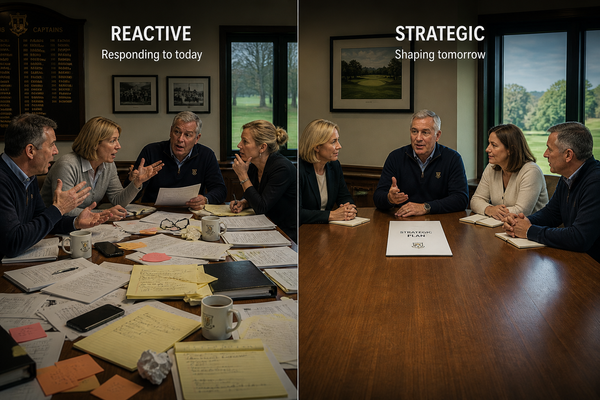
At this point, clubs tend to intervene. Reminders are issued, marshals are deployed, and members are encouraged to keep up. These measures are not without value, but they are often misdirected. They focus on behaviour in an environment where behaviour is already constrained. Asking players to move faster when there is nowhere to go does not solve the problem. It simply transfers responsibility from the system to the individual, where it is far less effective.
There is also a reluctance to confront the central trade-off at the heart of the issue. Increasing the number of tee times increases access, but it also increases pressure on the course. Reducing intervals may appear to improve availability, but it often degrades the experience. This tension between quantity and quality is rarely addressed directly, because the immediate benefit of more tee times is easy to measure, while the long-term cost of slower play is not.
Members may secure a time on the sheet, but that does not mean they enjoy the round. As delays become routine, behaviour begins to shift. Some players avoid peak times altogether. Others reduce how often they play. Competitions become less appealing, and casual rounds feel less spontaneous. Over time, engagement softens, not because the course lacks quality, but because the experience of playing it has changed.
This is where the commercial impact begins to surface, although it is rarely linked directly to pace of play. A slower course does not immediately reduce revenue, but it influences behaviour in ways that eventually do. Members who play less frequently engage less with the club as a whole. They spend less time in the clubhouse, participate less in events, and feel less connected to the rhythm of the club. What began as a scheduling decision gradually becomes a cultural one.
The most effective clubs approach this differently. They do not start with the assumption that players need to change; they start by examining the system those players are operating within. They measure actual round times rather than relying on estimates. They assess how different group sizes affect flow. They look at where delays consistently occur and adjust accordingly. Most importantly, they are willing to accept that optimal pacing may require fewer tee times, not more.
This is not an easy decision. Reducing capacity can feel counterintuitive, particularly in clubs where demand is high and access is closely guarded. There is always a concern that members will react negatively, that availability will become an issue, or that the perception of fairness will be challenged. But the alternative—maintaining a system that consistently produces slow play—carries its own cost, even if that cost is less visible.
Clubs that make this adjustment often find that the overall experience improves quickly. Rounds feel more fluid, waiting becomes less frequent, and the course feels less crowded even when it is busy. The atmosphere changes, not because players are behaving differently, but because the structure is supporting them more effectively. Pace becomes something that is naturally maintained rather than actively enforced.
Communication, when aligned with this approach, becomes more credible. Instead of asking members to solve a problem they cannot control, the club demonstrates that it understands the issue and is taking responsibility for addressing it. Expectations are clearer, and compliance becomes easier because it feels reasonable. Members are far more likely to support a system that works than one that simply asks them to compensate for its shortcomings.
None of this suggests that individual responsibility disappears. There will always be players who take longer than they should, and there will always be moments where awareness and etiquette matter. But focusing on those exceptions without addressing the broader structure is unlikely to produce meaningful change. The system shapes the majority of behaviour, and until that system is examined properly, slow play will remain a persistent feature of the club.
Ultimately, the question is not whether slow play can be reduced. It can. The question is whether clubs are willing to accept where the responsibility lies. Because while it is easier to ask members to play faster, it is far more effective to create an environment where they can.
Pace of play is not an accident. It is designed, whether intentionally or not. And in most cases, it is designed long before the first tee shot is struck.