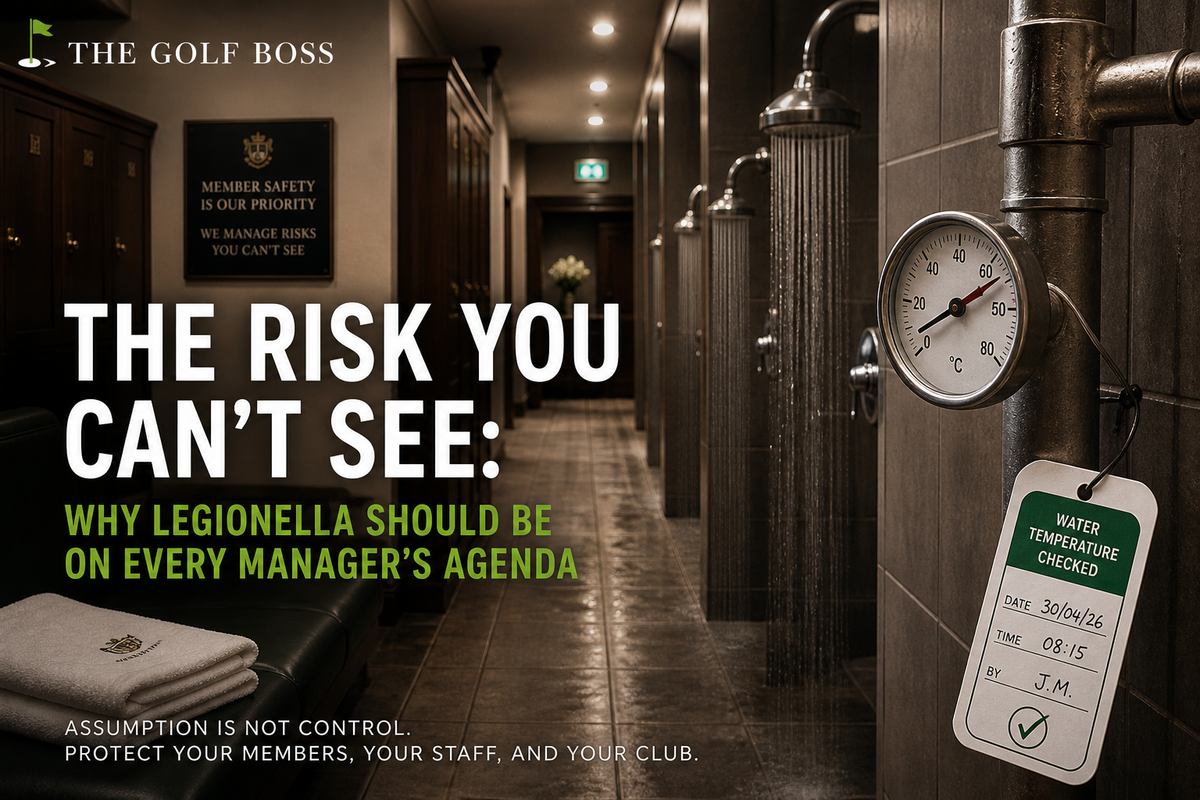
The Risk You Can’t See: Why Legionella Should Be on Every Manager’s Agenda
Course conditions can be assessed at a glance. Staffing issues reveal themselves quickly. Financial pressures, while sometimes complex, tend to surface in ways that demand attention.

By James Fairmont.
It is rarely discussed, often assumed to be under control, and almost always underestimated. Legionella risk in golf clubs sits in that uncomfortable space between awareness and action—and that is precisely where the danger lies.
There are certain risks in golf club management that are visible.
Course conditions can be assessed at a glance. Staffing issues reveal themselves quickly. Financial pressures, while sometimes complex, tend to surface in ways that demand attention.
Legionella is not one of those risks.
It does not announce itself. It does not present early warning signs that are easily recognised. It exists quietly within systems that are often taken for granted—water tanks, pipework, showers, taps—operating entirely out of sight and, in many cases, out of mind.
That invisibility is what makes it dangerous.
Most golf clubs are aware of Legionella in principle. It is not an unknown concept. There is a general understanding that it relates to water systems and that it carries health implications. Beyond that, however, the level of engagement varies considerably.
In too many cases, it rests on assumption.
An assumption that a risk assessment was carried out at some point. An assumption that systems are being maintained correctly. An assumption that someone, somewhere, is responsible for monitoring it.
Assumptions are not control.
And in this context, they are not sufficient.
Golf clubs, by their nature, present a number of environments where Legionella risk can develop. Locker rooms with infrequently used showers. Sections of pipework that experience low flow. Water storage systems that may not be routinely inspected. Seasonal fluctuations in usage that create periods of stagnation followed by sudden demand.
None of these conditions are unusual.
All of them require management.
The responsibility for that management does not sit in isolation. It is not purely a technical issue to be delegated and forgotten. It is a matter of governance, of duty of care, and ultimately of leadership.
A club is responsible for the safety of its members, its staff, and its visitors. That responsibility extends beyond what is visible and into areas that require deliberate attention to identify and control.
The starting point, in any responsible approach, is a proper risk assessment.
Not a document that exists to satisfy a requirement, but one that reflects the reality of the club’s systems. It should identify where risks exist, how they are being managed, and what actions are required to reduce them. It should be current, relevant, and understood—not simply filed.
Too often, this is where the first gap appears.
Risk assessments are carried out once and not revisited. Changes to the building, to usage patterns, or to infrastructure are not reflected. Over time, the document becomes less accurate, and the confidence placed in it becomes increasingly misplaced.
A risk assessment is not a static exercise.
It is the foundation of an ongoing process.
That process includes temperature control, which remains one of the most effective ways of managing Legionella risk. Water must be stored and distributed at temperatures that prevent bacterial growth. This requires not only the correct system design, but regular monitoring to ensure that those temperatures are consistently achieved.
Again, this is an area where assumption can creep in.
A system may be capable of delivering the correct temperatures, but without regular checks, there is no certainty that it is doing so. Variations can occur. Equipment can fail. Settings can drift. Without measurement, none of this is visible.
Sampling provides an additional layer of assurance.
It is not always required at the same frequency in every environment, but where it is used, it offers confirmation that control measures are working as intended. It moves the conversation from “we believe the system is safe” to “we know the system is performing within acceptable limits.”
For many clubs, this level of oversight feels excessive.
Until it isn’t.
The consequences of failing to manage Legionella risk properly are not theoretical. They carry legal implications, reputational damage, and, most importantly, potential harm to individuals. These outcomes are rare, but rarity should not be confused with impossibility.
The purpose of risk management is not to respond to incidents.
It is to prevent them.
What makes this particularly challenging in a golf club environment is that Legionella management does not produce visible benefits. There is no immediate improvement in the member experience. No obvious return on investment. No moment where the outcome is celebrated.
Instead, the result is the absence of a problem.
And in management, the absence of a problem is often the hardest outcome to value.
This is where leadership becomes critical.
A manager must be willing to prioritise areas that do not generate immediate recognition, but which are fundamental to the safe operation of the club. They must ensure that systems are not only in place, but functioning as intended. They must ask questions, seek evidence, and maintain oversight.
Delegation is necessary.
Abdication is not.
Working with competent contractors is an important part of this process. Specialist support can provide expertise, carry out testing, and advise on compliance. But external support does not remove internal responsibility. The club must remain informed, engaged, and accountable.
It is also important to recognise that compliance is not a fixed point.
Regulations evolve. Best practice develops. What was considered sufficient five years ago may no longer meet current expectations. Without periodic review, a club can fall behind without realising it.
This is not about creating complexity.
It is about maintaining control.
The most effective clubs tend to approach this in a straightforward way. They know where their risks are. They have up-to-date assessments. They monitor temperatures consistently. They carry out sampling where appropriate. They document what they do. And, importantly, they understand why they are doing it.
There is no sense of overreaction.
There is simply clarity.
For those that have not reached that point, the path is not difficult, but it does require attention. It requires a willingness to look beyond the visible aspects of the club and into the systems that support it. It requires the discipline to maintain processes that may not feel urgent, but which are essential.
And it requires an honest answer to a simple question:
Are we certain this is under control, or are we assuming that it is?
That distinction matters more than most.
Because in the end, Legionella risk is not defined by whether it exists.
It is defined by whether it is being properly managed.