Your Committee Isn’t Strategic. It’s Reactive.
By James Fairmont
Most golf club committees work hard, meet regularly, and care deeply about their club. Yet despite all of that effort, many struggle to move forward in any meaningful way. The reason is not a lack of commitment. It is the absence of strategy.
Golf club committees are rarely short of effort. Members give up their time, attend meetings, review reports, and engage in discussion with a genuine desire to contribute positively to the club. They care about standards, about finances, about member experience. They are, in most cases, well-intentioned and committed to doing what they believe is right.
And yet, many clubs find themselves in a position where progress feels limited. Decisions are made, actions are taken, but the overall direction of the club remains unclear. Issues arise, are addressed, and then replaced by new ones. The cycle continues, often with increasing activity but little sense of forward momentum.
The problem is not effort.
It is focus.
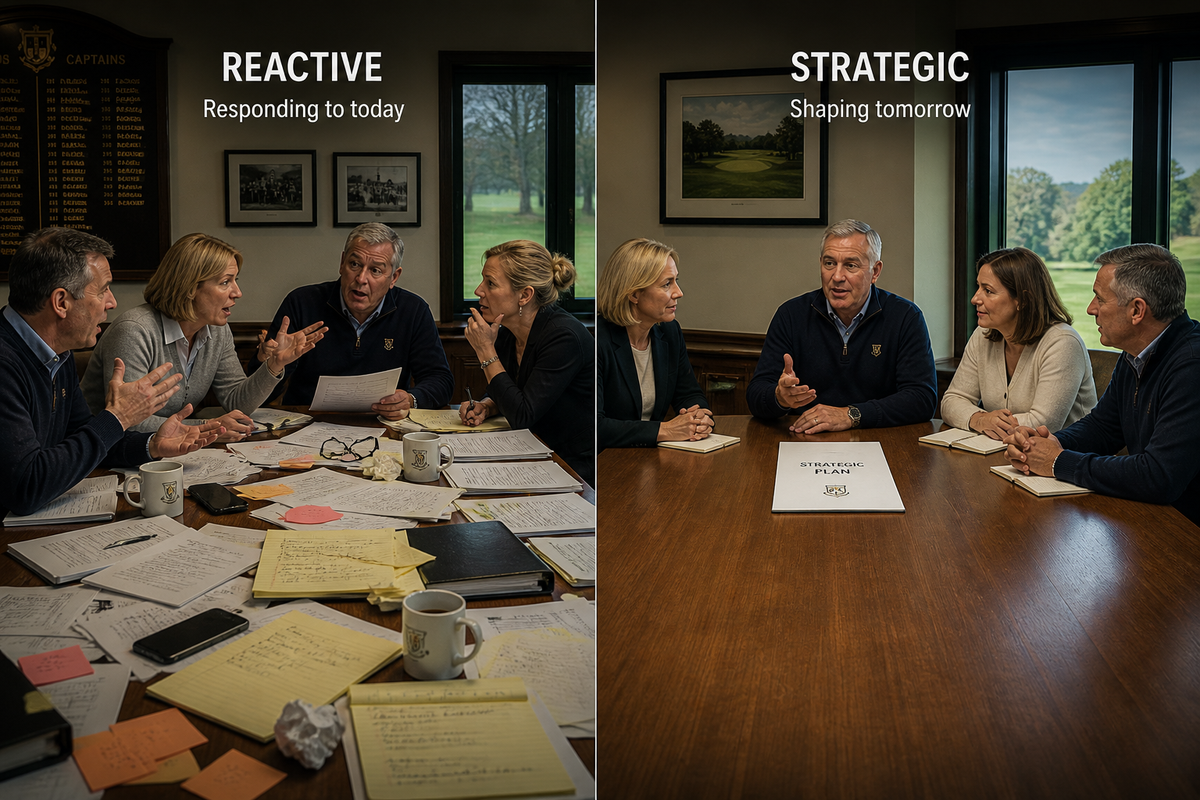
More specifically, it is the absence of a clear, shared strategy that guides decision-making over time. Without that, committees do not become ineffective, but they do become reactive. They respond to what is in front of them, rather than working towards something beyond it.
This distinction is subtle, but critical.
A reactive committee is not inactive. On the contrary, it is often extremely busy. Meetings are full, agendas are long, and discussions are detailed. But the content of those discussions is largely driven by immediate concerns—course conditions, staffing issues, member feedback, financial pressures, operational challenges. Each of these is valid. Each requires attention.
The difficulty arises when they become the entirety of the conversation.
When every meeting is shaped by what has just happened, or what needs to be resolved in the short term, there is little space left for considering what the club is trying to become. Decisions are made in isolation, responding to specific issues, rather than contributing to a broader plan.
Over time, this creates inconsistency.
One decision may prioritise cost control, another may focus on improving standards, a third may respond to member demand for increased access. Individually, each decision can be justified. Collectively, they may not align. The club moves, but not always in a single direction.
This is where the absence of strategy becomes most visible.
Strategy is not simply a document. It is a framework for decision-making. It provides clarity about priorities, about trade-offs, and about what matters most. It allows committees to assess options not only on their immediate impact, but on how they contribute to a longer-term objective.
Without that framework, decisions default to the most pressing issue in the room.
This is understandable. Urgency has a way of dominating attention. A complaint from members feels immediate. A staffing issue requires action. A financial pressure cannot be ignored. These matters demand response, and it would be irresponsible to overlook them.
The challenge is that urgency and importance are not the same.
A strategic committee understands the difference. It recognises that while urgent issues must be addressed, they should not define the direction of the club. It creates space to consider questions that are less immediate, but more significant. What type of club are we trying to be? What experience are we aiming to deliver? How should our resources be allocated over time?
These questions are not always comfortable. They require discussion, and sometimes disagreement. They require a willingness to look beyond current practice and consider alternatives. Most importantly, they require time—time that reactive committees often feel they do not have.
This is where the pattern reinforces itself.
Because meetings are filled with operational issues, there is little opportunity to step back. Because there is little opportunity to step back, strategy remains undefined. Because strategy is undefined, decisions continue to be reactive. The cycle persists, not through intention, but through structure.
Breaking that cycle does not require a complete overhaul of governance.
It requires a shift in emphasis.
Committees need to move from asking, “What do we need to fix?” to asking, “What are we trying to achieve?” That question reframes everything that follows. It does not remove operational issues from the agenda, but it places them in context. It allows decisions to be assessed not only on whether they solve a problem, but on whether they move the club closer to its objectives.
This shift also changes the nature of discussion.
Instead of focusing solely on individual issues, committees begin to consider patterns. Recurring complaints are not just problems to be addressed, but signals to be interpreted. Financial pressures are not just constraints, but indicators of how resources are being used. Operational challenges are not just obstacles, but opportunities to refine how the club functions.
The conversation becomes broader, and in doing so, more useful.
There is also an important role for leadership in this process. The chairperson and senior committee members set the tone for how meetings are conducted. If the focus remains entirely on immediate issues, that is where the committee’s attention will stay. If space is created for strategic discussion, it signals that longer-term thinking is not optional, but essential.
The manager, too, plays a critical role. Positioned between the operational realities of the club and the governance structure above it, they are often best placed to identify where decisions are becoming reactive rather than deliberate. Their input, when encouraged and properly considered, can help bridge the gap between day-to-day management and long-term planning.
However, this only works where there is clarity about roles.
A common challenge in golf clubs is the blurring of responsibility between committee and management. When committees become overly involved in operational detail, they limit their ability to think strategically. When managers are drawn into constant reporting on immediate issues, they have less capacity to contribute to longer-term planning.
Clear boundaries do not reduce involvement.
They improve it.
A committee that focuses on direction, priorities, and oversight allows management to focus on delivery. In turn, management can provide better information, more relevant insights, and stronger support for strategic decisions.
The result is a more effective relationship.
It is also worth recognising that strategy does not eliminate uncertainty.
Golf clubs operate in environments that are subject to change—economic conditions, member expectations, regulatory requirements, and external competition all play a role. A strategic approach does not remove these variables, but it does provide a way to respond to them more consistently.
When the direction of the club is clear, adjustments can be made without losing coherence. Decisions can evolve, but within a defined framework. The club remains flexible, but not uncertain.
This is what many reactive committees lack.
Not the ability to make decisions, but the structure to ensure those decisions align over time.
From a member perspective, the difference is noticeable, even if it is not always articulated. Clubs that operate reactively often feel inconsistent. Standards fluctuate, priorities shift, and communication can feel fragmented. Clubs that operate strategically tend to feel more stable. Decisions appear connected, even when they involve change. There is a sense that the club knows what it is doing, and where it is going.
That perception matters.
Members may not see the detail of committee discussions, but they experience the outcomes. Consistency builds confidence. Clarity reduces frustration. A sense of direction reinforces trust.
These are not abstract benefits.
They influence engagement, retention, and the overall health of the club.
None of this suggests that committees need to become corporate boards or adopt complex planning processes. Simplicity, when applied properly, is often more effective. A small number of clear priorities, regularly reviewed and consistently applied, can provide more value than an extensive strategy document that is rarely referenced.
What matters is not the format.
It is the discipline.
The discipline to step back from immediate issues, even when they demand attention. The discipline to ask whether decisions align with longer-term objectives. The discipline to maintain focus, even when the pressure to react is strong.
Without that discipline, committees will continue to work hard, make decisions, and address issues, but the overall trajectory of the club will remain uncertain.
With it, the same effort produces very different results.
Because in the end, the difference between a reactive committee and a strategic one is not the people involved.
It is how they choose to use their time, their attention, and their decisions.
And that choice shapes everything that follows.