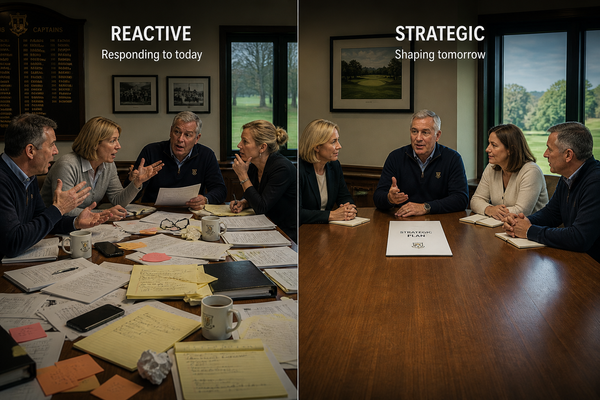
The Committee Problem: Why Golf Clubs Struggle to Make Decisions
Committees exist for a reason. They provide governance, accountability, and a connection to the membership. They ensure that decisions are not made in isolation and that the direction of the club reflects the people who use it.


Committees exist to guide golf clubs. Too often, they slow them down. The issue is not the people—it is how decisions are made, delayed, and diluted over time.
By James Fairmont
Every golf club has a structure.
On paper, it is clear, logical, and well-intentioned. A committee is formed to represent the membership, provide oversight, and ensure that decisions are made in the best interests of the club. A manager is appointed to run the operation, implement strategy, and maintain standards.
It is a system that should work.
And yet, in many clubs, it does not.
Not in an obvious or dramatic way. There are no daily crises. No visible breakdowns. Instead, something quieter happens. Progress slows. Decisions take longer. Momentum becomes harder to maintain. Good ideas lose energy before they are ever fully realised.
Over time, the club begins to feel as though it is standing still.
This is not a failure of intent.
It is a failure of structure.
The Ideal vs The Reality
Committees exist for a reason.
They provide governance, accountability, and a connection to the membership. They ensure that decisions are not made in isolation and that the direction of the club reflects the people who use it.
In theory, this creates balance.
In practice, it often creates friction.
The distinction between governance and operations becomes blurred. Committees begin to move beyond setting direction and into influencing how that direction is delivered. Decisions that should be straightforward become layered with opinion. Issues that could be resolved quickly are deferred for further discussion.
The result is not better decision-making.
It is slower decision-making.
The Slow Drift into Complexity
Very few committees set out to complicate things.
It happens gradually.
A small decision is brought forward “just to be sure.”
A second opinion is sought “for completeness.”
A discussion is extended “to hear all views.”
Each step feels reasonable. Sensible, even.
But collectively, they begin to change the nature of how the club operates.
Simple decisions become agenda items.
Agenda items become discussions.
Discussions become deferred decisions.
And in the space between intention and outcome, momentum is lost.
The Comfort of Consensus
One of the most persistent characteristics of committee-led environments is the desire for agreement.
Consensus feels safe. It reduces conflict. It creates a sense of unity. It avoids the discomfort of disagreement.
But it comes at a cost.
When decisions are shaped to satisfy everyone, they often become diluted. Strong ideas are softened. Clear direction becomes ambiguous. Actions are adjusted to accommodate differing views, rather than aligned around a single objective.
The result is rarely poor.
It is something more frustrating.
It is average.
And average, repeated over time, has a cumulative effect.
The Manager’s Position
Perhaps the most complex aspect of this structure is the position of the manager.
The manager is expected to lead the operation. To deliver results. To maintain standards. To move the club forward.
At the same time, their ability to act is often constrained by a system that requires consultation, approval, or alignment before decisions can be implemented.
This creates a quiet tension.
Responsibility sits with the manager.
Control, in many cases, does not.
It is an arrangement that can work—if roles are clearly defined and respected.
But when they are not, the manager becomes something else entirely.
Not a leader, but a facilitator.
Not a decision-maker, but a translator of competing views.
Over time, this changes behaviour.
Decisions are framed more cautiously.
Initiative is tempered.
Risk is avoided.
Not because the manager lacks capability, but because the environment does not fully support decisive action.
The Cost of Delay
What makes this dynamic particularly difficult is that the cost is rarely immediate.
A delayed decision does not cause a visible problem.
A postponed initiative does not create a crisis.
A softened strategy does not fail overnight.
Instead, the impact accumulates.
Opportunities pass quietly.
Improvements are implemented later than they should be.
Standards begin to vary.
The club continues to operate, but without the sharpness that defines high-performing organisations.
From the outside, nothing appears wrong.
From the inside, progress feels harder than it should.
The Illusion of Control
Committees often believe they are maintaining control by being involved in decision-making.
In reality, they may be doing the opposite.
By extending discussions, revisiting decisions, or influencing operational detail, they create an environment where clarity is reduced rather than strengthened.
Control is not created through involvement.
It is created through structure.
Clear roles. Clear authority. Clear boundaries.
Without these, even well-intentioned oversight can become interference.
Why Some Clubs Break the Pattern
Not all clubs experience this problem to the same degree.
The ones that function well tend to share a common understanding of how decisions are made.
Committees focus on direction, not detail.
Managers are trusted to deliver within that direction.
Disagreements, when they occur, are resolved with clarity rather than deferred through discussion.
Most importantly, there is an acceptance that not every decision requires universal agreement.
Progress, in these environments, feels different.
Quicker. More confident. More consistent.
What Needs to Change
The solution is not to remove committees.
They are an essential part of the structure of most golf clubs.
The solution is to redefine how they operate.
To be clear about where governance ends and management begins.
To accept that leadership requires space to act.
To recognise that speed, in many cases, is not recklessness—but effectiveness.
This requires trust.
Trust in the manager.
Trust in the structure.
Trust that decisions made with clarity are more valuable than decisions delayed for comfort.
It also requires discipline.
The discipline to resist unnecessary involvement.
The discipline to allow decisions to stand.
The discipline to prioritise progress over perfection
Final Thought
Most golf clubs do not struggle because they lack ideas.
They struggle because they struggle to decide.
And in an environment where momentum matters, where standards depend on consistency, and where opportunities do not wait, the ability to make clear, timely decisions is not a luxury.
It is a necessity.
Because in the end, a club is not defined by what it discusses.
It is defined by what it does.