
Why Good Greenkeepers Trust Data More Than Instinct
The demands placed on modern golf courses have changed. Expectations are higher, tolerance is lower, and the margin for error has narrowed considerably.

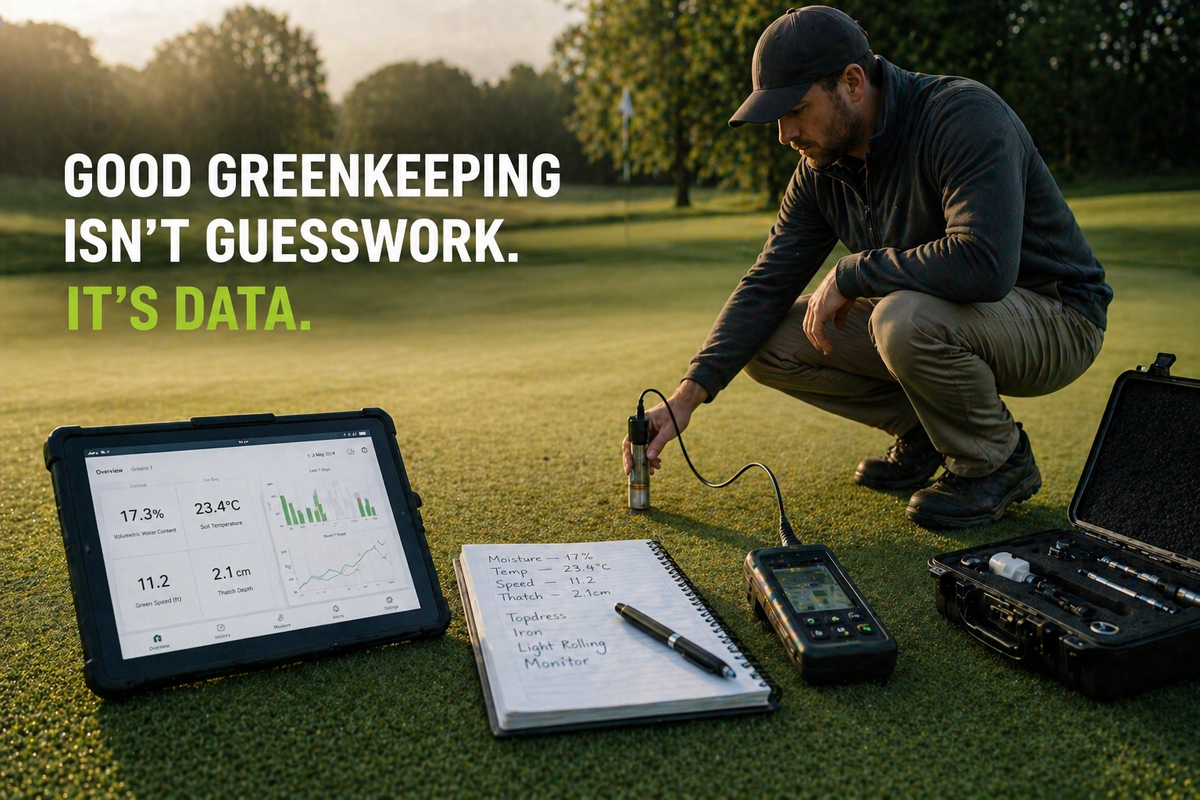
Experience matters. Instinct has value. But in modern turf management, neither is enough on its own. The difference between good conditions and consistent excellence increasingly comes down to one thing: data.
By Dr. Rowan Field
There was a time when greenkeeping relied almost entirely on experience.
A skilled course manager could walk a green, feel the firmness underfoot, observe the colour of the turf, and make a judgement that would guide the day’s work. Weather patterns were understood through familiarity. Soil behaviour was learned over years. Decisions were made instinctively, informed by observation and reinforced through repetition.
That approach still holds value, but it is no longer sufficient.
The demands placed on modern golf courses have changed. Expectations are higher, tolerance is lower, and the margin for error has narrowed considerably. Surfaces are expected to perform consistently across varying conditions, often under levels of play that would have been considered excessive in previous decades. In that environment, relying solely on instinct is not a mark of experience. It is a limitation.
Golfers today expect more than simply playable conditions. They expect consistency. They expect greens to roll at predictable speeds, fairways to behave uniformly, and surfaces to respond in ways that align with what they have experienced elsewhere. Comparisons are constant, whether spoken or unspoken. A member does not judge a course in isolation; they measure it against every other course they have played.
This creates a pressure that is both visible and subtle. Visible in complaints, feedback, and expectations around competitions. Subtle in the quiet assumption that standards should simply be maintained, regardless of external conditions. Meeting those expectations requires more than observation. It requires precision.
Instinct, for all its value, is inherently inconsistent. What feels firm one day may feel different the next, even under similar conditions. Visual assessments of turf health can be influenced by light, moisture, and expectation. Judgements about moisture levels, compaction, or nutrient requirements can vary depending on who is making them and when. This does not mean instinct is wrong. It means it is incomplete.
Data does not replace experience. It sharpens it.
Objective measurement allows greenkeepers to understand conditions with a level of accuracy that instinct alone cannot provide. Moisture meters reveal what the eye cannot see. Firmness testing quantifies what the foot can only estimate. Growth potential models provide insight into how turf will respond before it actually does. Instead of reacting to what appears to be happening, the course team can act based on what is known.
Consistency is where data delivers its greatest value. When measurements are taken regularly, patterns begin to emerge. Moisture levels across greens can be compared. Variations in firmness can be tracked. Nutrient applications can be aligned with actual requirements rather than assumed need. Over time, this builds a detailed understanding of how the course behaves, not just how it looks on a given day.
This allows for a more controlled approach to management. Adjustments can be made with confidence. Inputs can be targeted more precisely. Variability, which is often the source of golfer frustration, can be reduced.
There is also a communication advantage that is frequently overlooked. One of the ongoing challenges in golf clubs is explaining course conditions to members. Decisions that make perfect sense from a turf management perspective are not always understood by those experiencing the outcome. Without data, explanations can feel subjective. With data, they become credible.
A course manager can demonstrate why irrigation is being applied. They can explain why surfaces are slower or firmer than expected. They can show how conditions have changed over time and what is being done to manage those changes. This does not eliminate criticism, but it changes its nature. It moves the conversation away from opinion and towards understanding.
Despite these advantages, the adoption of data-driven approaches is not universal. In some cases, this is due to cost. Equipment requires investment. Systems require time. Data collection requires discipline. In others, the resistance is cultural. There is a belief that experience should be enough, that long-standing knowledge of a course outweighs the need for measurement, and that data introduces unnecessary complexity.
These concerns are understandable, but they overlook a fundamental shift. The course is no longer judged solely by those who manage it. It is judged by those who play it, and those players are increasingly informed, increasingly vocal, and increasingly demanding.
Clubs that fail to adapt do not immediately decline. The change is gradual. Standards become harder to maintain. Variability increases. Small issues take longer to resolve. From the outside, the course may still appear good, but internally the effort required to sustain that standard increases. This is where data becomes not just useful, but essential. It reduces uncertainty, improves efficiency, and allows for better use of resources.
Its value extends beyond day-to-day management. Course decisions are not purely operational. They involve planning, budgeting, and long-term development. Data provides a foundation for these decisions. It allows clubs to understand how resources are being used, where investment is required, and what impact different approaches are having. It provides evidence when decisions need to be justified, whether to a committee, a membership, or external stakeholders.
Without this, decisions rely heavily on opinion. With it, they are grounded in reality.
None of this suggests that instinct should be discarded. Experience remains critical. A greenkeeper’s understanding of their course, built over years, is invaluable. But that experience should be supported by data, not replaced by it. The most effective course managers are those who combine both, using observation to guide their thinking and measurement to confirm it.
Golf courses have always been complex environments, and that complexity is only increasing. Weather patterns are less predictable. Usage levels are higher. Expectations are more demanding. In that context, relying solely on instinct is no longer enough.
Data does not make decisions easier.
It makes them better.