Why Some Golf Clubs Feel Unwelcoming Within Five Minutes
Golf clubs are full of invisible knowledge. Long-standing members understand the rhythm, the etiquette, the small but important details that govern how things operate.

You can have a beautiful course, a strong membership, and a proud history—and still make people feel like they don’t belong. The problem is rarely obvious. That’s what makes it dangerous.
By Alexandra Green
It does not take long to form an impression of a golf club.
In fact, it often happens before a ball is struck.
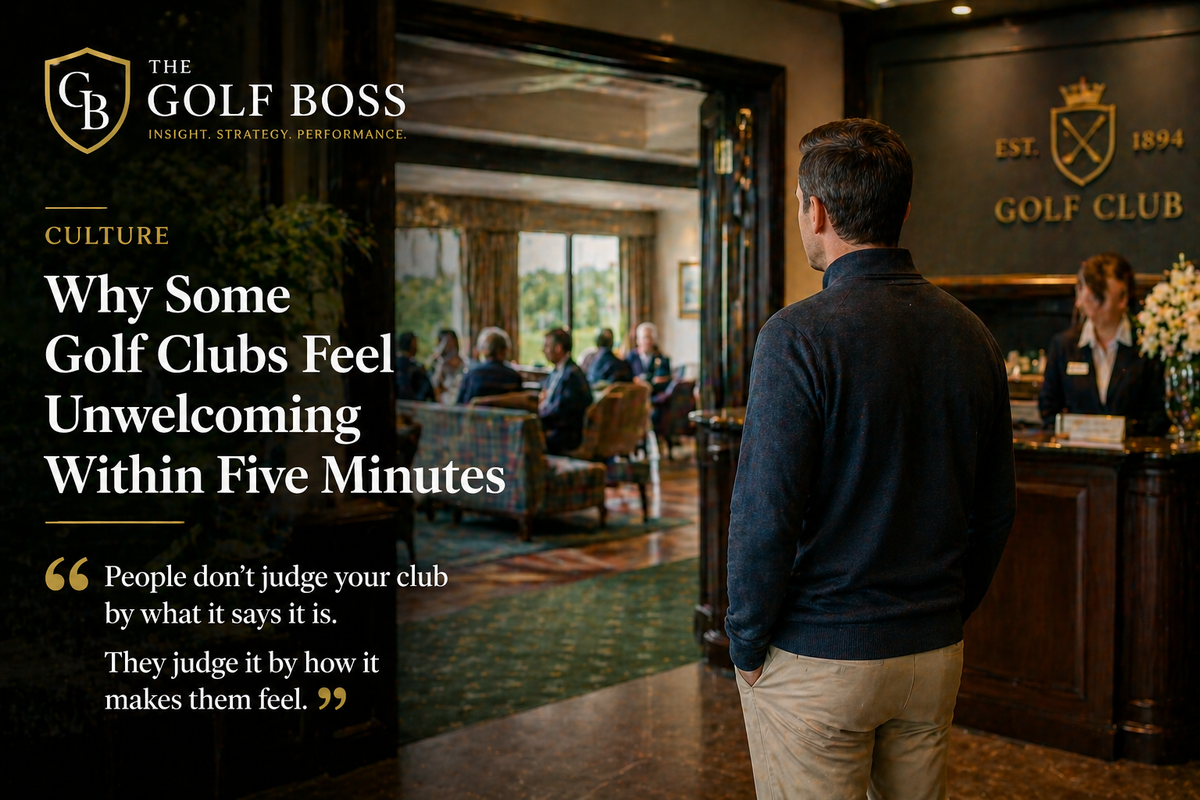
A visitor arrives. They walk through the door, pause briefly, and begin to take things in. The tone of the greeting. The layout of the space. The way people look up—or don’t. The subtle signals that suggest whether this is a place they are expected to be, or merely tolerated within.
Within five minutes, a judgement has been made.
And in many clubs, that judgement is quietly negative.
What makes this particularly challenging is that it is rarely intentional. Most golf clubs do not set out to exclude people. They do not consciously design environments that feel cold or unwelcoming. On the contrary, many believe they are friendly, open, and proud of their traditions.
But culture is not what a club believes about itself.
It is what a visitor feels.
That distinction matters more than most realise.
There is a common assumption that a strong culture is one that protects history. That maintains standards. That preserves the identity of the club. These are all valid ambitions. But when culture becomes overly inward-looking, it begins to prioritise comfort for existing members over accessibility for everyone else.
The result is not always hostility. More often, it is something quieter.
A slight hesitation at reception.
An assumption that “you’ll know how things work.”
A lack of clear guidance.
An atmosphere that feels established—but not open.
None of these, in isolation, are significant. Together, they create a barrier.
And barriers, once felt, are rarely forgotten.
One of the most revealing questions a club can ask itself is a simple one:
What would this feel like if I were here for the first time?
Not as a member of long standing, familiar with every nuance and routine—but as a guest, or a prospective member, or someone who does not yet understand the unwritten rules.
Would it feel obvious where to go?
Would it be clear what is expected?
Would someone take ownership of making that experience easy?
Or would it rely on the individual figuring it out for themselves?
Too often, it is the latter.
Golf clubs are full of invisible knowledge. Long-standing members understand the rhythm, the etiquette, the small but important details that govern how things operate. Newcomers do not. When that gap is not actively managed, it creates discomfort—and discomfort rarely encourages return visits.
There is also a tendency to underestimate the power of observation.
People notice more than we think.
They notice who is acknowledged and who is ignored.
They notice whether staff appear confident or uncertain.
They notice whether members are engaged with the space—or simply passing through it.
They notice, above all, how they are made to feel.
And feelings, once formed, are difficult to reverse.
This is where many clubs miss an opportunity.
They invest heavily in the course, the clubhouse, the facilities. They focus on visible improvements. Tangible upgrades. Things that can be pointed to and measured.
But culture does not sit neatly in a budget line.
It is built through behaviour.
It is reinforced through consistency.
And it is experienced in moments that are easy to overlook but impossible to ignore.
The clubs that do this well are not necessarily more modern, or more expensive, or more progressive. They are simply more aware.
They understand that a warm, confident welcome is not an optional extra. It is a strategic advantage.
They recognise that clarity reduces anxiety. That small gestures—acknowledging someone, offering direction, explaining what happens next—can transform an experience.
They do not assume familiarity.
They create it.
There is also a broader shift taking place, whether clubs acknowledge it or not.
Golf is no longer the closed environment it once was. Expectations are changing. New members, younger members, and increasingly diverse groups are entering the game. They bring different perspectives, different experiences, and different expectations of what a club should feel like.
Clubs that respond to this thoughtfully tend to grow stronger.
Clubs that ignore it tend to become quieter.
Not immediately. Not dramatically. But gradually, as engagement softens and new opportunities fail to convert.
None of this requires a complete reinvention.
It requires attention.
Attention to how people arrive.
How they are greeted.
How clearly things are explained.
How easy it is to feel comfortable.
These are not complicated changes. But they do require intent.
Because culture, left unmanaged, does not stand still.
It drifts.
And when it drifts in the wrong direction, it rarely announces itself.
It simply reveals itself in the quiet decisions people make:
Not to return.
Not to join.
Not to recommend.
Final Thought
Every golf club has a culture.
The question is not whether it exists, but whether it works.
Because in the end, people do not judge a club by what it says it is.
They judge it by how it makes them feel—often within the first five minutes.