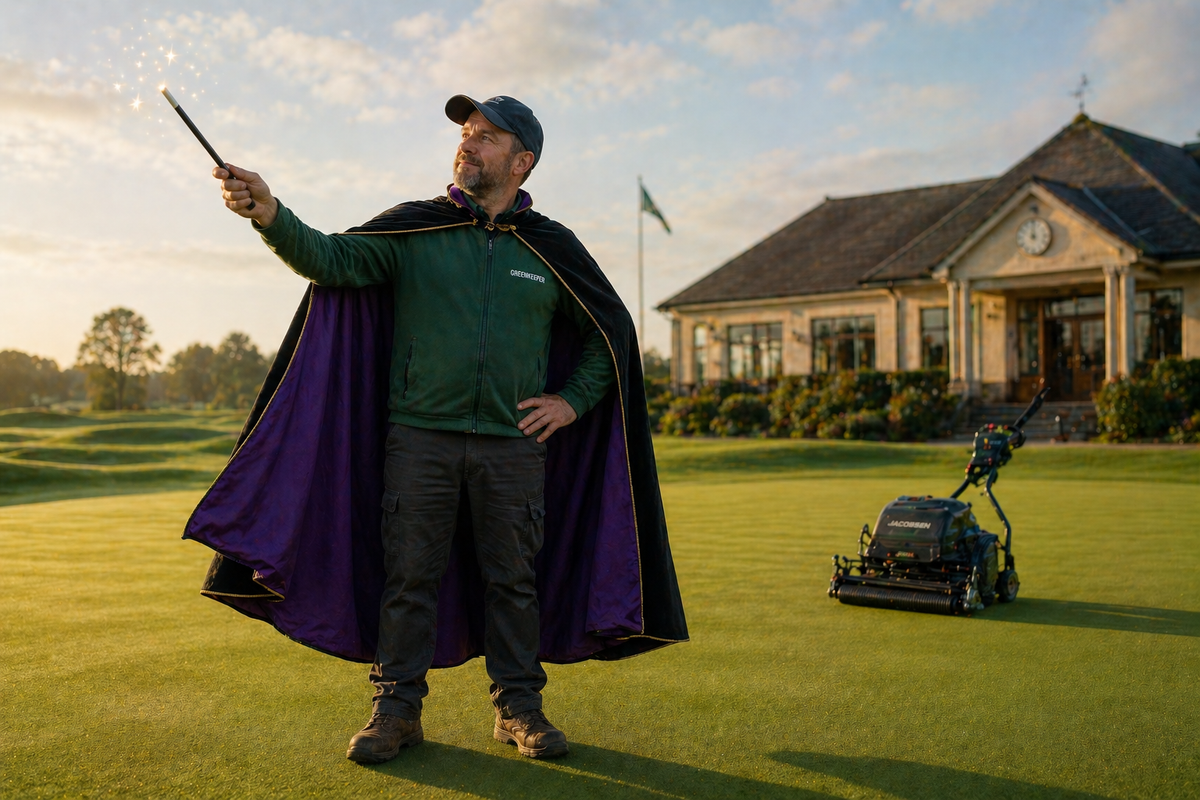
Why Your Greenkeeper Is Not a Magician
Because unlike most of the assets within a golf club, the golf course is not fixed. It is alive. It responds to its environment in ways that cannot be controlled entirely, only managed.
Perfect greens are expected year-round. Nature does not agree. Understanding the realities of turf management may be the most important step a golf club can take.
By Dr. Rowan Field
There is a quiet expectation in many golf clubs that the golf course should be consistently excellent.
Not occasionally good, or seasonally strong, but reliably—almost effortlessly—at a high standard. Greens should be smooth, fairways should be lush, and bunkers should look as though they have been prepared moments before every round.
It is an understandable expectation.
It is also, in many cases, an unrealistic one.
Because unlike most of the assets within a golf club, the golf course is not fixed. It is alive. It responds to its environment in ways that cannot be controlled entirely, only managed.
Temperature shifts. Rain arrives—or doesn’t. Growth surges, then slows. Disease appears without invitation. Traffic builds in certain areas and quietly wears them down over time. None of this happens neatly, and none of it happens on a schedule that suits competition play.
What golfers often experience as inconsistency is, in reality, the natural behaviour of a living surface.
Consistency, when it exists, is not the default state. It is the result of careful and often invisible work. It requires planning, timing, and a willingness to make decisions that may not deliver immediate results. Even then, it remains fragile. A week of poor weather or heavy play can undo a great deal of progress.
This is where misunderstanding begins to take hold.
There is a common belief that course conditions can be adjusted quickly. That if something is not quite right, it can be corrected within a few days. In truth, turf does not respond to urgency. It responds to conditions and time. Improving surface quality is a gradual process, one that depends on root development, soil health, and recovery cycles that cannot be accelerated simply because there is a competition approaching.
Some of the least popular practices in golf—those moments when surfaces are disrupted—are, in fact, the most important. Aeration, topdressing, overseeding: these are not cosmetic exercises. They are essential interventions that allow the course to sustain quality over the long term. The frustration they cause in the short term is often the price of avoiding much greater problems later.
Clubs that avoid these practices to maintain appearances rarely benefit from that decision. What is gained in the moment is usually lost over time.
There is also a practical reality that is sometimes overlooked. The condition of a course is directly linked to the resources available to maintain it. Expectations tend to rise naturally, but the investment required to meet them does not always follow at the same pace. When the gap between expectation and resource becomes too wide, pressure builds—often unfairly—on the people responsible for delivering the outcome.
The most successful clubs tend to manage this better than most.
They communicate.
They explain what is being done and, more importantly, why. They give members a sense of the plan, the direction, and the reasoning behind decisions. When golfers understand that a temporary disruption is part of a longer-term improvement, their tolerance tends to increase. When no explanation is offered, assumptions quickly take its place.
Patience, in this context, is not passive. It is a deliberate choice to allow the right processes to take effect over time. It is also one of the most difficult things to maintain in an environment where expectations are immediate and visible.
The golf course sits at the heart of every club. It deserves attention, investment, and ambition. But it also requires a degree of realism.
Because while golfers may expect perfection, the course itself operates under a different set of rules.
And nature, unlike the membership, has no interest in the competition calendar.